‘I liked how it was before’, and other things never to say to a writer

This is draft 29. Since the project began you’ve had 23 names for your lovingly-crafted protagonist (hard to believe she began as illiterate – now she’s a linguistics professor!) and 52 versions of chapter eleven, and losing the first eighty pages was one of the best decisions thus far in your writing career (not to mention the brilliant new twist at the end – Booker judges, look out!), and you lovingly parcel your putative book with the digital version of string and brown paper, and bundle it off to the friend/family member/significant other who read drafts 14, 17 and 20.

And one merry day, when you’re happily minding your business, the feedback arrives: ‘I liked how it was before!’

And the person who offers this feedback invariably seems to think it’s a nice thing to say, for some reason I’ve never quite managed to fathom.

For the writer it’s rather like laying the very last brick in the flat-pack house you’ve built for yourself – from your own skin and bones – to be told by a clipboard-wielding bastard that you’ve got to knock it down again.

Dear People of Planet Earth, there is a rule of thumb to be used (with your nearest and dearest) in such situations: sharing one’s writing with friends and/or family members is rather like sharing one’s body. If you wouldn’t want to hear it post-coitally, then consider the chance that your friend/spouse/significant other is equally un-keen to hear it post-novelly.

For each of my Top Five Most Hated Responses imagine – go on; you’ll enjoy it, I bet – that you’ve just done the deed for the very first time with the (wo)man of your dreams, and you’re naked in all of your pale English glory on top of their tumbled silk sheets and you’re asking – you’re actually asking! – said conquest to rate your technique twixt those sheets.

1. It was fine!*

2. I only got halfway, but… it was good until then!

3. Well, obviously it needs work, but I’m sure you know that!

4.  It was quite interesting!**

5.  It reminded me a bit of something else!

* Exclamation marks, I’m sorry to say, seem obligatory in these circumstances.

** Never use the word ‘quite’ except to say ‘quite, quite’, as in ‘quite, quite magnificent’.

Sharing your writing really is that exposing. No writer expects (no serious writer expects) kid gloves from a paid editor/mentor, but when it comes to friends and family – jeez, go easy. Pause for a second – with fingers on keyboard, or pen in your fingers – and run your response through the post-coital sensitivity filter. It takes many years – perhaps decades – to write something really worthwhile: if you hobble a writer mid-stream on that journey they might just give up and do something more boring instead. And the world – as I’m sure we agree – has enough boring people already.

You don’t have to be mad to work here, but it helps.

If there was one thing I could change about the world, it’s this. (And it comes with World Peace as a BOGOF, you’ll be happy to know.)

I would alter the fabric of time and space so that novels could be written outside of the writer’s regular life, in another dimension, connected by only the merest of threads to this thing we call reality. I’ll call this dimension the Novelling Pocket. The entrance – I’d guess – is a little like Alice’s descent to Wonderland and, once safely inside, two things happen at once:

(a) Time comes to a halt – or, perhaps, more exactly: there is no time.

(b) Your emotional baggage is checked at the door.

If you haven’t immediately appreciated the joys of the Novelling Pocket then you, Sir and/or Madam, are (a) not presently writing a novel, (b) have never attempted to write a novel, and (c) are blessed with the sort of straightforward mindset that (if mindsets were bridges) would vaguely resemble Exhibit A:

Exhibit A.

Exhibit A.

Whereas I, Sir and/or Madam have found myself dogged, for the last thirty years of my life, with Exhibit B.

Exhibit B. Photograph from http://travel-wonders.blogspot.co.uk

Exhibit B. The Rickety Bridge in Nepal. Photograph from travel-wonders.blogspot.co.uk

I think you see the difficulty.

This week (in jolly old reality) things went tits up for me. And so… after two weeks of frantic activity (see last month’s post on blurting) all work on the novel has come to a stop. (And the fact that I almost said ‘come to an end’ shows the ricketiness of my bridge at the moment.) I’m basically fastened together with red wine and string. When I open my mouth (aka pick up my pen) I am utterly mute. I have nothing. I’m empty. I want to dive into the novel and blot out the world, but instead I’m stuck, shivering, by myself, on the top board with a swimming pool of people underneath me, pointing and staring. (Actually, all right, I’m on the sofa eating crisps, but…) Last week I was Tom Daley. This week I’m an effing beach ball.

(N.B. The bridge, thing: that’s so last paragraph. Do try to keep up.)

So you know what I said (roughly 42 hours ago) about two things that happened at once in the Novelling Pocket: the (a) and the (b), and the (a) was time stopping? It used to be reason (a) that I needed it for (most of all), but now, hello, what’s this? It turns out I have shed-loads of time, now I’ve ceased any writing. The hours have magically trebled, quadrupled, quintupled (is that a real thing?), and each individual hour – each minute – seems infinitesimal in its length as I sit here unable to dive.

The profession of writer does tend to be linked with depression (Woolf, Hemingway, Plath) as this article reminds us. And yet – in spite of this blog post’s title – it’s one of the things that’s hardest to do when depressed: if you do write, the odds are you’ll write something twisted and crabbed and polluted – and, while poetry is known for its therapeutic effects, I am wholehearted in the opinion that novel writing is not. And, besides, I’m not Woolf. I’m not Plath. I’m very much more ordinary than that. To quote Plath’s Tulips, ‘I have nothing to do with explosions.’ I want nothing to do with explosions. All I want is to write again.


No one else is going to write it for you.

So, diet books, huh? (Don’t worry; you haven’t come to the wrong website.)

The Fast Diet. The 5:2 diet. The Super Juice Diet. The Atkins Diet. The New Atkins Diet. The H2O Diet (really?!?). The Lemon Detox (mm, tasty). And that’s leaving aside the more emotive titlesSlim to Win. Skinny Bitch. Clean and Lean… (Meaning what, exactly? That fat people are dirty?) images

Business, of course, is booming. (I even own one of these books myself – although not the disturbingly-named ‘Skinny Bitch’, I hasten to add.) I’m not saying that diets don’t work, per se, I’m just asking – by show of hands – who here doesn’t already know exactly how to lose weight?

[Insert drumroll.] Yes, you guessed it! Healthy eating and exercise.

That’s not how we are, though, is it? We humans. We want to believe in magic, in miracles. Why – in today’s culture of instant gratification – would we want to eat more vegetables and fewer crisps when a nice man called Atkins is telling us, actually, we can shrink to the width of a Twiglet whilst stuffing our pie-holes with bacon all day?

Which brings me, at last, to the point of this blog.

Tap the phrase how to write a book into the Amazon search bar and what do you get? 14,784 results. There’s Novel Writing for Dummies, and How Not To Write a Novel (this one, to be fair, is quite funny), something (I haven’t read) with the frankly extraordinary title of Piss Or Get off the Pot: Time to Write Your Novel, and Louise Doughty’s rather good A Novel in a Year (which doesn’t really expect you to write your novel in a single year, but A Novel in Three to Four Years On Average would certainly be a less enticing title).

‘What’s that?’ says the author of A Novel In Six Months. ‘You’re going to waste a whole year on that shit? If you buy my book, you’ll be done in six months… then the other six months you’ll be sunning yourself in the Bahamas on the proceeds…’ 

‘Look, I don’t want to interrupt, but—’

‘Who the hell are you?’

‘I’m the author of Book in a Month.’

‘Ah.’

You’ve got to love an optimist. (Actually, no you haven’t. I can’t bloody stand them myself.) These listings are full of them: ‘No Plot? No Problem!’ screams one.Writing the Breakout Novel.’ ‘How to Write a Damn Good Novel.’ Best of all is: ‘Novel: Plan it, Write it, Sell it.’ I don’t know who author Lynne Barrett-Lee is but I probably need her to stand in my living room shouting at me. ‘But, Lynne, this character – I’m not really feeling him… and this scene, it’s not working somehow…’

To which Lynne would reply: ‘What are you whining about, you dick? I’ve told you everything already –  just plan it, write it, sell it!’ Full_Metal_Jacket_small

At this point I should say: this is not, repeat not, a rant against books about writing. I’ll freely confess I own loads of the buggers myself. I’m a magpie for quotes about writing (I’ve gathered them into a Scrivener file) and, loathsome hypocrite that I am, I’d actually like to write one myself, one day, when I’ve earned the right to do so with a published book or two. I will also confess that I teach short story writing (hence the large collection of said books) so, clearly, my stall is already set out on this issue: many aspects of the craft of writing can be taught – or at least semaphored, for the eagle-eyed to pick up on – but it’s also time to admit to myself that the purchasing of a book entitled Nail Your Novel will not (and did not, in fact) enable me to nail my novel. Not that it wasn’t a sensible, thoughtful, insightful read: it’s just that these books are the literary version of The Lemon Detox and, while they might give you a shot in the arm on occasion – and frequently do – at their most basic level they’re cramming your pie-hole with bacon when really it’s cabbage and tap dance you need. By all means read a book on technique. Take a course. Get some practise. And never say never: it may be that 79.7% of published authors owe their success to Book in a Month, or Book in a Week, or Book in the First Seven Seconds of Post-Coital Bliss, in which case, yes, I’ll look foolish. But one of my loveliest former students (who’s recently tasted some much-deserved literary success) once told me the best piece of advice I gave her was this: ‘No one else is going to write it for you.’

The unpalatable truth is that catch-all solutions don’t exist: the fact that you’ve purchased Piss or Get off the Pot will ultimately make no difference. You may piss, yes. But, equally, and more likely, you’ll stagger off the pot – or remain there, trousers round your ankles, no closer to nailing, stapling, or building your novel from spare bits of string than you would have been sans pot-pissing guide. Any shot in the arm will have dwindled around page 12 – if you’re anything like me, that is – and you’ll face the cold, hard truth that no one (not even Lynne Barrett-Lee) is going to write the book for you. And even if she did, she’d be unlikely to finish it in a single frigging month. So step away from A Novel in Two-Eighths of a Nano-Second and welcome to the real world.

You’re going to hate it.


Why writing is not the same as reading, and other painful truths.

Ah, reading.* How do I love thee? Let me count the ways…

1) A nice chunky novel = soaking your brain in a long, hot bath. (Although anything by David Peace = an episode of tachycardia.)

'The Bath of Knowledge' designed by Vanessa Mancini.

‘The Bath of Knowledge’ designed by Vanessa Mancini.

2) A good short story = an invigorating dip in the North sea. 

3) Most poetry = ten seconds of toe-tickling, or an accidental pinprick. (N.B. The very best poetry = blinding flash of glory, or leg mangled horribly in man-trap. Which brings me back to David Peace…)

Each experience may, of course, feel different for you. But the odds are, if you’re reading this post at all, that you somehow – in your own unique manner – derive at least a modicum of pleasure from the act of staring at words on a page. And if, like me, you attempt to place words on a page yourself there’s a fair chance you like it a helluva lot.

There’s an outside chance that you might even like reading about other people’s lives a little more (sometimes) than you enjoy living your own. But, ssh, we won’t go into that. 

It’s important – if you’re one of these people, like me, who would shrivel and die without books – that you take a few moments to remind yourself of the following fact: Writing is Not the Same as Reading.

Well, duh, you might be thinking. But, actually, I’ve a theory that most of us – at least once in our writing ‘careers’ – have fallen prey to the following thought:

(S)he makes it look so easy. 

From this thought we move rapidly to: (a) If it looks easy, it must be easy… (Reaching for laptop and/or pen and paper.) Closely followed, an hour or so later, by (b) What’s wrong with me? Why can’t I do this? (In manner of Marlon Brando wailing, Stellaaaaa!)

I thought rocket science was hard. Then I tried writing!

I thought rocket science was hard. Then I tried writing!

The thing is, you see, the more you love reading – the more you equate it with soaking your brain in a long hot bath – the more likely it is that you’ll come to assume that writing is similarly pleasurable. And, yes, in its own twisted way it is pleasurable – very – and yes, you are right to assume they are sister activities (writing, for instance, should never be done without first having liberally steeped one’s brain in the bathtub of literature). But – and as I often say when catching sight of my rear end in a mirror, it is a big but(t) – if reading is the blue-eyed photogenic child with the nicely brushed hair who remembers her pleases and thank yous, then writing, I’m sorry to say, is the family’s black sheep that they generally keep locked away in a Mrs Rochester-style attic arrangement to wheel out, under duress, on special occasions.  

That squeaking noise, yes, it’s the Bath Tub as Metaphor being dragged out again, and if writing a novel is in any way akin to the wallowy soak of reading one then you’re likely to find it’s a bath tub with horribly faulty taps that spurt cold water over your toes every time you relax, or a wobbly cat stalking perilously around the rim with its claws out, poised to fall in. Think this scene’s going well, do you, Lynsey? SPLASH. Think again.

As a reader you plunge yourself into a ready made world of another’s invention, and everything – if it’s done as it should be – feels wonderfully real. Organic, you might say. As if it just happened to bloom on the page, like a plant or a flower. As if there was never a poor fool, like you, fiddling endlessly (painfully, sometimes) with every last page. When you enter a room in a novel and marvel – oh look – at details they’ve chosen to etch in the scene (the frost-stars on a window; a sunrise of bright yellow wallpaper; a fly on a cobweb trapeze) just remember you’re only a guest. And, like guests in real houses, you won’t be obliged to take part in the manual labour of styling the place (anymore than your host would expect you to take out the rubbish or sweep up the gunk down the back of the oven).**

You know where I’m going with this As a writer (and this is the painful bit) you’ll have to lay your own bloody floor before you can even set foot on it (let alone lay the carpets). A few leggy strides and, yup, you’ve run out of floor again: time to get down on your knees and build it. You strip off and dive in your bath tub – to find out (with chilling effect) that it hasn’t got taps yet.

So only know this: writing is locked in that attic for good reason. Forewarned is forearmed. Approach with caution.

I’ll leave you with this quote, from Jonathan Myerson in The Guardian, in the hope that it jollies you up as it did me (with its appreciation of the trickiness and slowness of it all): ‘good writing comes from someone sitting alone in a room, undergoing a distinctly unphotogenic process of self-discovery. Good writing comes from experimentation, word by word, sentence by sentence, chapter by chapter, and thus it grows into something that probably even the author did not predict and could not have foreseen. The writer needs a chance to try again, fail again, fail better.’

*This post is about the pursuit of reading, as opposed to the Berkshire city of Reading. (I did, however, have an excellent weekend at the Reading Festival in 1990. Just thought I’d mention.)

** My own personal house porn comes in A.S.Byatt’s PossessionAmong the many (better known) delights of this novel, Byatt also Gives Great Room.

‘In quickness is truth’: blurting and the art of novel maintenance.

In quickness is truth. The faster you blurt, the more swiftly you write, the more honest you are. In hesitation is thought. In delay comes the effort for a style, instead of leaping upon truth which is the only style worth deadfalling or tiger-trapping.

This quote comes from Ray Bradbury’s Zen in the Art of Writing, and matches exactly the newest approach I’ve been taking to the Magnum Opus.

Like Bradbury, I’ll call this Blurting.

The things that I’m blurting won’t even be part of the book – they’re just backstory (just, she says: as if backstory wasn’t important) – but the thing is I’ve got myself stuck. I’m so deep in the mud of the middle (the ‘muddle’ we might as well call it) that only a radical tactic will save me.

And so – though I’m usually chained to my keyboard – I’m writing by hand, in an A4 pad full of bits of old lesson plans, notes for old stories, occasional shopping lists (Lynsey’s top tip: if your notebook’s too fancy or pricey or perfect you’ll find yourself frightened to write anything for the fear of spoiling it; drafts are best done in the tattiest book you can find). What you blurt should be legible – just – but don’t stop to find typos (writos?) or fill in missed words. There’s no need. All you’re catching I think, when you blurt, is the story.  And stories are more than just words. (It is nice, though, when a character uses words you hadn’t thought of. Private proclivities, for instance. Scarpered. Specimens. A few of my favourites today.) 

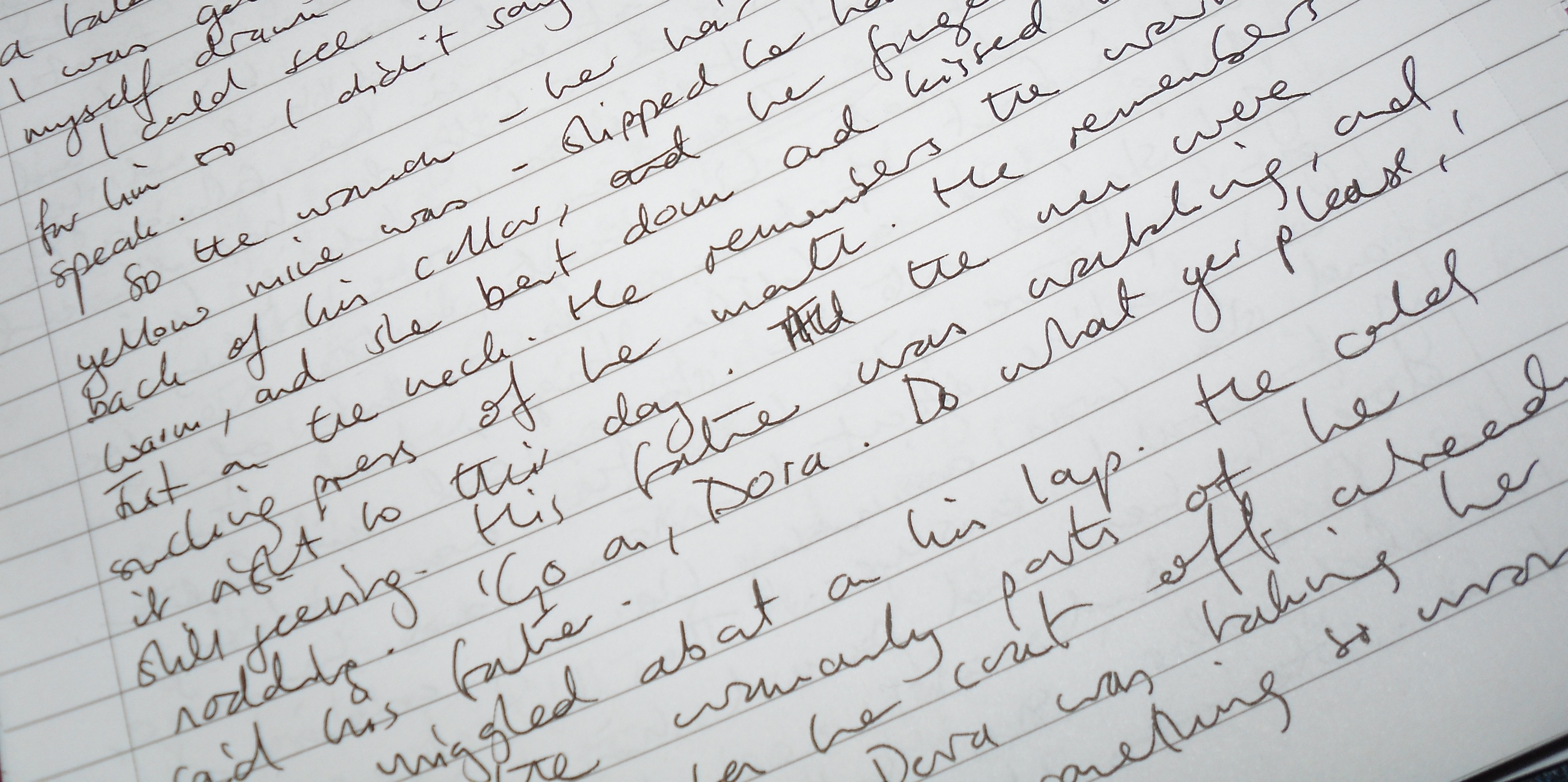
An excerpt from todays blurtings.

An excerpt from the Blurtings

It’s dangerous, though. Look closely at the picture above and you might spot a woman’s name: Dora. There’s no one in Madder Hall called Dora. Not yet… But the deeper I burrow, the closer I get to the core of it all: what’s been causing the muddle, I think, is the fact there are two diverse strands to my story – and, damn it, they just won’t join up. Every bone in my body is aching to MAKE THEM join up and get back to the novel already, for god’s sake (impatience turns quickly to panic); this draft should be finished by now – but these things can’t be rushed. ‘If poetry,’ said Keats, ‘comes not as naturally as leaves to a tree, it had better not come at all.’ A novel needs rather more planning, of course, than a poem, but just like a poem a novel comes mainly – completely? – from the jolly old subconscious, and blurting allows the subconscious to speak.

I imagine my own as a kindly old lady, proffering tea. On a day like today there is cake as well. ‘You might want to sit down, dear,’ she says. ‘I’ve got good news and bad news. The good news is great news: you’re really immersed in this story. You’ve found all the voices, so well done, you.’ She puts a gloved hand on my knee. She’s called Babs. Or Val. ‘Here’s the bad news, dearie. Your two strands won’t ever join up. It’s beyond our abilities. See what this Dora character has to offer, why don’t you? What’s that, dear? Speak up, please. This isn’t the novel you wanted to write? Why no, dear, whoever said it should be? It’s the one want to write. Let me cut you a slice of this cake…’

It’s raining stories. Hallelujah!

Something odd has been happening.

Elves have been taking the off-cuts from my novel and turning them into short stories.

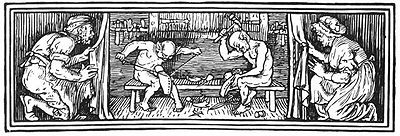
The Elves and the Shoemaker: Lucy Crane's illustration for the 1886 edition.

The Elves and the Shoemaker: Lucy Crane’s illustration for the 1886 edition. I’m the one in the mob cap.

Short stories aren’t quite as useful as shoes, of course: nevertheless, I prefer them. Whether they’ll end up saleable is anyone’s guess. But that isn’t important. I woke up this morning to find that a story was writing itself in my head. It was all I could do to get up, have a wee, source some caffeine, and get myself back to the laptop in time to record it – like taking dictation – before it was gone.

It took less than an hour. For me, that’s unheard of. And yes, it was dreadfully written, with cliches and adverbs and notes to myself in the middle… but stories – whole stories – don’t land in my lap very often. I’ve waited my whole life long for my own little Ariel moment, when stories (or poems) fall out of the sky and you just have to catch them, and now (touching wood) here it is. Something pure, unselfconscious: not fussy, or tricksy, or technical. Nothing yet of the caliber of Tulips or The Moon and the Yew Tree or Lady Lazarus, but you know what they say about beggars and choosing.

So anyway, dear subconscious, I’m wearing a hard hat to bed tonight in case somehow, by magic, the rest of my novel falls out of the sky.

A thing about endings.

It’s the end of the year and I so wanted things to be different. I wanted to be on the brink, on the verge. AT THE END.

Or at least at the end of the end: the end stretch, with the ending in sight or the endgame about to begin –

Have I said the word ‘end’ enough times yet? I keep thinking and hoping that somehow it might be like Satan. Or Voldemort. If you just say the freaking word often enough then it somehow, magically, finds you.

But, sigh. Not to be.

Never mind. There’s a new year approaching (apparently, people keep saying) and maybe this new year will bring resolution of more than one kind… If I solemnly swear, like a good girl, to glue my fat butt to the chair (with no tweeting or internet boggle) for seven-hour stretches three days a week will you please, please (God, Satan*, Voldemort… whoever’s listening) resolve all my flippy-flappy plot strands somehow into something resembling an ending?

You will? That’s great!

See you in 2014…

* Satan, I was just kidding about you. Don’t help me. Oh, and please don’t visit me either.

Ti-tum, ti-tum, ti-tum, ti-tum… or the Music of Prose.

What do you do to relax? I do various things. I read books, I watch films, I take baths. I play Chopin’s Waltz in F major on the piano – delighting my neighbours – and listen to ASMR videos on youtube (and if the latter has you thinking I’m probably mad then you’ll know it for sure by the end of this post).

Above all, though, I write.

Is she kidding, you’re thinking? She writes to relax. I should clarify, here, that I don’t mean proper writing with plot arcs, and meanings, and narrative drive. That’s like juggling whilst riding a unicycle – backwards – and, wonderfully absorbing and rewarding as that is (when it’s working), I’d never describe it as soothing.

Proper writing is like this.

Proper writing is like this.

No, no, I mean something called free writing. You let your pen loose on the paper (or fingers on keyboard) and, well, you just write. You don’t think, you don’t shape, you don’t plan. Your brain flops – I can actually feel it, somehow – and you splurge your thoughts onto the page. Automatically. Writing without really thinking about it. Like jiggling around in a nightclub, say, as opposed to performing the lead role in Swan Lake on stage for a ravenous crowd at Sadler’s Wells.

Free writing feels like this.

Free writing feels like this.

And, NB, when I say this is writing ‘automatically’, I don’t mean to say this is ‘automatic writing‘ – in which practitioners believe they’re communing with spirits: the only communing you’ll do here is with your own brain – your subconscious, specifically – which is far more entertaining (and, just occasionally, more alarming, if you’re currently unfamiliar with its deepest enclaves). The technique has been fairly widespread among writerly types since Dorothea Brande’s ‘Becoming a Writer’ way back in 1934 (which you can read in its entirety here, with an intro by John Gardner, whose own book, On Becoming a Novelist is equally deserving of your time and attention). We free-write in order to access our un- or sub-conscious, says Brande: the most playful – or childlike – part of our brains, that must function in tandem alongside the critical, conscious part (that decides if the plot makes sense, etc.) ‘You must teach yourself,’ she says, ‘not as though you were one person, but two.’

If you’ve never tried free writing before, you’ll find some great prompts here at practice writing.co.uk (choose a prompt that immediately zings in your brain – it’s more likely to resonate with you), or simply write ‘cold’ if you like (let your natural environment prompt you somehow). Back to Brande: ‘The unconscious is shy, elusive, and un- wieldy, but it is possible to learn to tap it at will, and even to direct it.’ The key here is practiceMy students divide into two clear camps: those who groan at the ‘f’ of the ‘free’ (and would rather poke sticks in their eyes than be let off the leash), while the other half champ at the bit to get started (and often have poetry somewhere behind them). You need to keep trying. The older you get, the more likely it is that your brain has erected complex fortification systems – a series of signs reading do not disturb. But a writer must play. I’m afraid it’s essential. You can’t run away from yourself – not forever: this process, for me, feels like switching the light off and groping around in the dark. You won’t know, till you reach out and grab them, what treats you might find. There are all sorts of things in that darkness, believe me, and maybe you’d feel that much safer by switching the light on but don’t, please, I ask you: the best stuff is shy and elusive, remember. It shrinks from the light.

‘But this post,’ you’ll be saying around about now – if your memory is better than mine – ‘was supposed to have something to do with the music of prose, whatever the hell that means.’ Well, yes. I’m now getting to that. It’s not something you’ll hear very often from advocates of free writing, but this is the way do it. Think back to the start of this post (it was ages ago) and you might recall something I said about Chopin? My twin loves are writing and music. The two come together sometimes. Where they meet with the least complication is here, in the dark of that treat-filled room where I do my free writing. The way I relax is to write for the rhythm alone: I don’t care about meaning, or sense, or self-censorship. All I can hear is the sound of the words, the ti-tum, ti-ti-tum, and the ebb and the flow of the language. Rhythm in English derives from a pattern of stressed or unstressed syllables: somehow I reach for an iamb or trochee or dactyl without even knowing exactly what iambs or trochees or dactyls are, but the rhythm entangles me, lulls me… relaxes me. Pushes me into the groove where I do my best writing, and opens the juiciest part of my brain where the good stuff is hiding.

Have you ever read prose that’s so fluid it’s sort of hypnotic? Tobias Hill (a poet as well as a novelist) is great at this; so, too, is his namesake, Tobias Wolff, in this ravishing extract from Old School‘it carried me back to those Sunday teas in the headmaster’s parlour, red leaves or snow or whirling maple seeds falling past the tall windows. The great Persian rug is covered with cookie crumbs. The air smells of the Greek master’s cigar. In the fat corner someone plays ‘Beautiful Dreamer’ on the tinkly upright, fragments of the melody floating just above our voices. We boys stand in circles…’ And so it goes on. It’s just lovely, right? Full of music and assonance. Swoon. (Although, crucially, Wolff breaks the rhythm sporadically: prose isn’t poetry, after all.) I could read it forever. In James Wood’s superb How Fiction Works he describes the ‘mathematical’ perfection of certain sentences; the writer’s ‘third ear’ that hears something beyond mere content. I don’t, by any means, lay claim to excellence as a writer (‘Authors come in two kinds,’ my mentor once told me. ‘Those who are natural storytellers… and, well… you’re the other kind, I think’) but the one thing I would say I’ve got is a fairly good ear for the music of prose. Which is bugger all use, of course, when you can’t tell a story, but, still, in my long writing life I’ve pulled one or two sentences out of the bag that I’m proud of. For me, that’s enough.

If you have too much time on your hands…

…you might like to read the sample that follows. It’s copied verbatim from one of my copious Free Writing files on Scrivener, written without even thinking about it, or stopping, or censoring anything. This here’s the part where you’ll think I’ve gone crackers, but read it aloud – very quietly, when nobody’s listening – and you might find it trips fairly easily (mad as it is) off your tongue.

And you know what? I quite like those card-playing dolls…

The dolls looked alarmed. They were sipping their cold tea from cups made of apples and holding their clenched hands alone on the table in front of them. None of their hands could manipulate scissors. They gazed in the far vacant distance. You never knew what they were thinking. Their eyes were completely devoid of sensation. Their bodies were heartless. They mostly wore tartan, or plaid as the little girl called it, and spoke of their long ago love affairs, over the border, when none of their hearts had been broken by boys, since they had none to break.

Was it good, the girl asked? This doll’s life? They replied that it was, that she ought to come try it. She said she preferred the boom-boom of her own real heart. They were sorry. They sat playing cards for a while. Could she join them? 

The littlest doll had an ace. The fat doll with the wig the same pink as a radish was holding the kings and the queens, and the elderly doll with no eyes had a two and a four. They weren’t sure what the game was, or who was the winner. The time was passed tolerably well in the nursery. Still the clock ticked, and at last when the rabbity hands had advanced to the ten and the seven they sighed and explained it was high time for bed.

If you’ve made it this far, grab your pen or your pencil and write fifty words – without stopping – on owls, or hearts, or cards. Feel the flow of the sentences. Jig your way through them, as if in a nightclub, and reach for a word not according to meaning but sound. When I’ve done this in class I’ve seen students come up with all sorts of ridiculous things, but they’ve often had something – a sort of a spark – that their conscious writing lacked. ‘If you never let yourself go,’ as Germaine Greer (sort of) once said, ‘how will you ever know how far you might have got?’

Exactly.

Plotters and pantsers and halfway houses.

You set your book in 1970s Britain and it’s only to be expected, I suppose, that at some point in the proceedings your cast will go on strike. The ‘C’ word hasn’t helped. By which, of course, I mean Christmas. My novel, like so many others, no doubt, has been gathering virtual dust while I’ve battled old ladies for last jars of mincemeat, and spent half my annual earnings on postage, and queued up for 22 hours for a £1.50 stocking filler (without which said stocking is bound to seem woefully empty somehow). But the rumblings had already started, to tell you the truth: I think Christmas was just an excuse, for this writer at least, to step back and take stock of the Magnum Opus. And one thing was stunningly, immediately obvious: my characters have gone Off Message. This isn’t all bad, though. As Isabel Allende describes it (on the utterly wonderful Brain Pickings): ‘When you feel the story is beginning to pick up rhythm—the characters are shaping up, you can see them, you can hear their voices, and they do things that you haven’t planned, things you couldn’t have imagined—then you know the book is somewhere, and you just have to find it, and bring it, word by word, into this world.’ This is all very comforting of course – because there’s (almost) nothing finer than spending time with characters who’ve sprung to life at last – but what of this thing we call ‘plot’? I had plans for these characters, way back when: an itinerary of activities to keep them all occupied, like overseas visitors you’ve dutifully – reluctantly – agreed to escort on a sightseeing tour: ‘No, but Tuesday we’re doing the Houses of Parliament. Windsor Castle’s on Wednesday. Madame Tussauds? But we’re not even going to Madame Tussauds… Look, I emailed this weeks ago…’

Once upon a time I had a plot. My cat was guarding it. He fell asleep. Perhaps that was the problem.

Once upon a time I had a plot. My cat was guarding it. He fell asleep. Perhaps that was the problem.

If you’ve come within sniffing distance of National Novel Writing Month then you’ll certainly know of the NaNo folklore that two types of writers exist, known as plotters and pantsers. The plotters, of course, are self-explanatory (lovers of file cards, character profiles, hard and fast outlines. Call round to their house and you’ll most likely find their CDs neatly marshalled according to some kind of arcane system – date of release divided by number of band members, for instance, multiplied by Pi). Pantsers are not German tanks, as you might be imagining, but rather are writers who fly by the seat of their pants (which is rather a wonderful image, when you really think about it). Call round to a pantser’s house of an evening and follow the trail of their last music session like breadcrumbs from one incorrectly-replaced CD to another. (As every unfortunate guest will know, I fall squarely in Category B.) But, of course, it’s not really that simple, is it? The late, great children’s author Diana Wynne Jones saw four distinct camps, not two, and I’m rather inclined to agree: 1. Careful planners (who need to know every last twist in advance). 2. Avid researchers (short on plot, but long on background). 3. Back to front and inside out writers (who might start with chapter 11). 4.  DWJ’s own method: ‘I know the beginning and what probably happens in the end, plus a tiny but extremely bright picture of something going on in the middle.’ (You can read the full article here. While it’s aimed at children, it’s perfectly pertinent, too, for the adult writer).

And when you've read the article, give yourself a treat and read this book. Pure joy from start to finish.

And when you’ve read the article, give yourself a treat and read this book. Pure joy from start to finish.

Myself, I’m a 4. I’ve tried plotting – I really have tried – but the plot (wildly good as it seems in the abstract) can only translate into concrete reality if the cast you’ve created decides to play ball. And, ay, there’s the rub. You can move them around all you like when they’re still only names on a neat set of file cards, but once they’re alive – I mean really alive – they can give you the old two-fingered salute any time they flipping well want to. ‘Characters are not created by writers,’ said Elizabeth Bowen. ‘They pre-exist and have to be found.’ And she’s right, I think – or, at least, in the sense that all characters (probably) spring into life as composites of the many hundred – thousand – people we’ve met in real life. They’re like teenagers (trust me on this; I’m the mother of one): and as every mum knows you can take a hot-headed teen to the instrument of your choice but you can’t make them practise… and so it is with characters. You can spend your whole morning with shoehorn in hand – ‘you will poison the schoolmaster’s wife, because have decreed it… but what do you mean you’re in love with the schoolmaster’s wife? Oh god, NO, because, look, now you’ve sunk the whole plot’ – till your characters head to the picket line, placards in hand, and perhaps they’re unusually stubborn, my cast, but they’re not going to budge, not a muscle, until I’ve re-written the script of their lives. Am I going to give in? Well, of course I am.

Oh, the times they are a-changin’ (or actually changed quite a long time ago without me bloody noticing).

When I first started hawking my stories round town, the only real tool at my writerly disposal was a manual typewriter approximately the size – and weight – of London, with an ever-increasing number of jammy keys, and malfunctioning ribbons.

Yes, ribbons.

Ribbons. Not just for little girls' hair.

Ribbons. Not just for little girls’ hair.

In those days ribbons had quite a lot to do with writing. They lived on two spools in the typewriter’s casing, and slowly unwound and rewound themselves, over and over again, till the ink was worn out. (Or, well, that’s how I remember it. Funny how something as normal as breathing for so many years seems so hazy and alien now. Take a trip here for the Wiki-How low-down.) At least, that’s what they did when they worked. But mine didn’t. I’d get to the end of one spool and I’d WIND BACK THE RIBBON BY HAND. That’s how much I wanted to keep writing. (For one memorable time in my life, I had two-tone print, like a half-baked sort of traffic light, with red at the bottom and black at the top.) If you wrote something silly you reached for the salaciously-named corrective fluid or (more often, if you were me) retraced your steps with a row of snarling Xs. A bit like barbed wiring.

To summarise: you had to be really ashamed of a line, in those days, to delete it.

I'm going all warm and squishy inside at the sight of this.

I’m going all warm and squishy inside at the sight of this.

The other thing I mentioned was the jammy keys. You’d literally hammer the words on the page, in those far-away days, and my hammers would sometimes – quite often – refuse to lie down again after I’d used them. Perhaps (in my fantasy land) they were trying to read what I’d written. More likely they needed some oil. Either way, it was quite an ordeal, most days, to get more than a handful of paragraphs onto the page. These machines were so flipping noisy you couldn’t type much after ten if you lived within listening range of other humans. Your fingers grew steadily flatter from thumping the keys. It was hard bloody work. It was manual labour. (See what I did there? Sorry.)

You sent off your stories by post (a nice pigeon arrived at your door with a clip round his leg, and you gently attached your short story and waved him goodbye). When you entered your work for a prize the results would arrive in a similar fashion, or maybe by telephone – landline, I mean – and then only, of course, if you’d won: if you hadn’t, and hadn’t requested a notification, you might never know the results.

When I hung up my writer’s gloves for a while (with a crippling case of The Block) things had already changed. Like Dylan, I’d long since gone electric (first with a plug-in typewriter – whoop! – then the humble Word Processor. Yes, I’m a sort of computer, but whoa there, girl, what’s this internet shopping you speak of? And today’s top compilation of Cats Being Jerks? Are you out of your tiny mind? I’m a word processor, sweetheart. For the processing of words).

Sometimes, laptop, much as I love you, I wish you were humbler and simpler and more single-minded. I wish you were more about processing words and less about oh what’s that nice shiny link over there – and, aw, that’s so cute – and, haha, that’s the funniest ever and – fifty-seven flagged emails I haven’t replied to – and sign this petition – and, oh, I’ll retweet that – and, yes, I love cutting and pasting, and googling for everything possibly relevant (certainly saves on the telephone calls to my dad: ‘Do you know when the sun sets in March?’; ‘When were seat belts made law?’; What does camphor smell of?’, etc) but my brain seemed to shape its thoughts more easily – in the tap-tap-tap-ding! of those olden days – when it took so much work to commit them to paper.

And competitions, too, have moved on. There are prizes for stories and poems, same as always, of course – but the stories have sub-sets now (flash fiction and memoir), and something Tania Hershman tweeted the other day about ‘drabbles’ had me reaching for my dictionary (by which, ahem, I mean googling for the definition) to learn that, no, these are not the off-spring of Margaret Drabble, but rather a tightly-laced Victorian governess of a story form: 100 words exactly. Ouch. That’s rigid. (Rigidity rather works, though, when it comes to short stories… but that’s for another post.) And the last prize I entered myself (the Fish Short Story Prize 2011) was entirely an online-affair. Did they want my address? No, they didn’t. But what if my email dies, somehow, I was thinking. How will they tell me I’ve won? (Oh, come on, we all think it. Fess up.) In the end I was short-listed (close, but no cigar), and my email continued to function as normal, and yes, the website crashed when the long list was published, but, ultimately, the world kept on spinning, and no-one but me was remotely sniffly or sad for the ritual of giving the big brown envelope a kiss for luck before sending it, actually, physically, off to its fate. Call me an old romantic, but, sigh, there was something I liked about that.

The Praise Sandwich: On Giving and Receiving Feedback

Anyone who’s ever had the pleasure of teacher training will have served up many a Praise Sandwich in their time. Unknown-1It goes a bit like this (do try to keep up if you can; it is tricky):

1. Say something nice.

2. Insert constructive criticisms.

3. Say something nice.

Having once had the pleasure of feedback from someone who omitted all three steps I can tell you there’s an art both to giving and receiving comments on a WIP. As the giver (unless you genuinely intend the giv-ee NEVER to write again) then, please, for the love of god – find something nice to say. It may be that you’ve seen a pile of vomit with more artistic merit, but comments such as ‘this line captured my attention’ and ‘what an interesting idea’ are noncommittal enough that you don’t look like an idiot whilst encouraging said ‘giv-ee’ to keep writing long enough to (just maybe) get a little bit better at it.

In my workshop I ask all participants to follow some simple rules when offering feedback:

1. ‘Show your working.’ (e.g. ‘This character wasn’t believable as a neurosurgeon, because on page 4 you described him as unusually clumsy’… as opposed to: ‘This sucked.’)

2. Adjust feedback according to which stage the draft is at. (A first stab? Stick to generalised comments on character, pace and structure. You might as well piss in the wind, at this stage, as tweak every sentence.)

3.  Don’t be a Grammar Nazi. (By all means, mark up the draft, but few workshops can survive an hour-long diatribe on the semi-colon.)

4. Remember: it’s not your story. Be careful not to impose your own style and/or interests on another writer. (‘What I think’s missing here is an S&M scene…’)

5. If you possibly can, read it twice (the first time without comments). Apply this to your own self-editing, too.

And the rules for receiving feedback?

1. Shut up and take it!

2. That’s it. Just shut up and take it.

Have you ever seen Hilary Mantel on Amazon arguing against one of Wolf Hall‘s one-star reviews? I’m guessing that’s a no. On the rare occasions When Authors Fight Back (you can have that if you want, Channel 5) they only ever make themselves a laughing stock. (See here for some bad behaviour from the self-published author of The Greek Seaman.) Practise for your own one-star reviews (no, seriously, practise: everyone gets them) by bringing up the drawbridge. Fine, speak out if a factual error’s been made, but otherwise: stiffen that lip; turn the Biblical cheek; keep a dignified silence. The one thing you ought to be doing is this: taking notes. Hide the notes in a drawer for a week if you need to. The odds are you’ll find, when you tiptoe towards them again, that the shit-storm you thought you got caught in was (a) not as turd-filled as first it appeared, and (b) at least partially justified.

images-1

Personally I don’t think this piece has enough adverbs in it.

Here, let me just take a break to admit that you may have a fair few buffoons in your workshop. We’ve all known a reader who blunders through prose with the grace and finesse of a spec-less Mr Magoo… who wouldn’t know quality prose if it came rubber-stamped from the government’s Quality Prose Department (which, thank god, doesn’t exist). In a workshop (as on twitter) you’ll soon learn the voices worth listening to. Use your judgement. Buffoons can be safely ignored (in fact, should be). And, likewise, if someone has clearly cast only the vaguest of looks at your work (from a passing train window, say) then start pinching that salt. The two blokes, Jesse Armstrong and Sam Bain, who later wrote one of my favourite programmes, Peep Showwere both in my final-year writing class at Manchester Uni and all these years later I still have fond memories of Sam Bain’s two-word response at the foot of my story: Well done. Not as harsh, of course, as the two word-review of Spinal Tap’s Shark Sandwich, but still. Two words? Two fingers, more like.

Unknown-2

The aforementioned team behind TV’s ‘Peep Show’. Oh, and Jesse Armstrong also co-wrote a little thing called ‘The Thick of It’. Not too shabby.

Never mind. I came top of the class and that, of course, is the salient point here. (And, while on the subject: there wasn’t much evidence, back then, of Sam Bain’s scriptwriting genius, although Jesse Armstrong produced a spectacularly horrible story called Pig Rodeo that, with hindsight, had more than the whiff of a Peep Show blueprint about it…) 

Most writers, of course, are at least 64% Jealous Bastard (rising to 86% if they’re currently on an MA). If you’re sharp-tongued yourself, I suggest you brace everything for the little-known phenomenon of The Revenge Drubbing, a feature of certain, power-hungry workshops. (I’ll see your ‘incomprehensible gibberish’, madam, and raise you a ‘slightly less fun than a coma’. Touché!)

Luckily, my own experiences with Mentor Extraordinaire Michelle Spring (as part of Arts Council England’s Escalator programme) have been as far removed from buffoonery, and drubbery, and two-word reviews, as humanly possible. That doesn’t mean I haven’t been force-fed a turd sandwich or two, but my lip is so stiff now it’s practically Botoxed. The news from the frontline was good today: all the bits I like best in my book are the bits she likes too.* So, onwards! (As my late, great, phonetic-namesake Lindsay Anderson was wont to say.

*Although apparently it’s got too many breasts in it…

The Third Suitcase (or How Many is Too Many Characters?)

So I know how many psychiatrists it takes to change a lightbulb (one. But the lightbulb’s got to want to change) and how to get four elephants into a mini (two in the front, and two in the back).

What I don’t know, good people, is how many characters I can reasonably cram in my novel.

Many have fallen already, in the thirteen months (not that I’m counting) since ‘Madder Hall’ first stuck its nose past the parapet of my notebook (‘Wheeling a stolen bicycle, an ordinary-looking girl with yellow hair…’)* As I sit at my desk (oh, all right, in bed), with a Pivotal Scene to be written today, I’m pondering whether or not to cull another.

Now someone (whose name I’ve forgotten) said something (I can’t quite remember) on Radio 4 once, while lightly discussing the Eleanor Catton book-beast that garnered this year’s Booker Prize. It went something like this: writing plots is like carrying suitcases, one in each hand. If you’ve constantly got to go back for a pesky third suitcase, then maybe your plot is too complex. (Do please shed some light on the source of this quote, if you know it.)

For me, this particular character feels like that pesky third suitcase. I keep on forgetting her. Leaving her under a bench on the platform. (She nearly got blown up once, by controlled explosion, for being a possible bomb.) She’s only half-packed, as I vaguely recall: there’s a dirty great lock on the strap that I can’t find the code for. More bothersome still, she’s the same shade and texture as one of my other cases. I can’t always tell them apart at a distance. (Insert pic, here, of the author scratching her chin.)

But she plays very nicely in tandem with somebody else (her young daughter), and killing her off may cause the fabric of Time Itself to be hopelessly torn apart (or else necessitate a largish chunk of rewriting, which is far worse, of course). So here I am straddling this chasm, my legs at unnatural angles (as modelled here by Leroy in Fame), Gene Anthony Raywhile the Pros and Cons swirl in my head. Do I welcome The Killer Inside Me or hack off that lock with a buzz saw and see what she’s hiding?

* As the re-writes have piled up (like hands playing One Potato, Two Potato) it turns out the yellow-haired girl can’t even ride a bike anymore. Which just proves the truth of this Rose Tremain quote (from the Guardian’s Ten Rules for Writing Fiction): ‘Respect the way characters may change once they’ve got 50 pages of life in them.’

A Case of the Glums, or The Feedback Limbo.

You know that thing when you’re halfway through tidying up and the room looks worse than it did in the first place and, GOD, you wish you’d never started?

Hello, novel.

As some of you may know by now (I bang on about it often enough), I was lucky enough to be chosen as one of the ten Escalator writers for 2013: my prize being (primarily) a year’s free mentoring from the wonderful writer Michelle Spring, creator of my second favourite female detective, Laura Principal. (No. 1 spot reserved, of course, for my childhood crush, Nancy Drew.) Every three months or so I bring joy to Michelle’s existence with 10,000 words or so of my putative novel. She waits – her breath bated, heart pounding, a light film of sweat on the palms of her hands – till my latest instalment has landed, at last, in her inbox, and life can have meaning again. (Or something like that.)

But, of course, as we know – courtesy of Nelly Furtado – All Good Things (Come to an End). And I’m writing this post from the uppermost step of the ride we call Escalator: poised to get off, with a businessman jostling his brolly behind me and somebody, late for a train, racing past in a fug of BO. The good ship Escalator has docked, at last, at the Port of Mixed Metaphors, and this mentoring session – on Monday – marks (sniff, sniff) the end of my year. So last night – deep breath – at a minute away from the witching hour, I gathered my last little bundle of words in a hastily-renamed file (originally titled ‘Massive Balls for Michelle’) and, sipping a last drop of wine for Dutch courage (South African actually – Porcupine Ridge; not too shabby for six quid, Sainsbury’s, thank you), I hovered my mouse over ‘send’ and I fired my words into the ether. Gulp. Now I wait until Monday, midday, for The Verdict.

Gulp

Gulp

These few days in Limbo are strange. Here I am with the ‘guiltless but damned’ of Dante’s Inferno: the virtuous pagans, the unbaptised, the Christ deniers. Excluded from heaven. Protected, so far, from the fires of hell. (Any writer who’s handed in work of a first draft quality for perusal by actual human eyes will appreciate hell as a metaphor here.) I mean, what are you meant to do while you’re waiting for someone to give you a yay or a nay? Are you right to be secretly yipping inside that you’ve hit on a really cool twist… or, come Monday, with nothing but tea to console you, will everything crumple to dust in the cold Cambridge light? Will you plod up the road to the station, loathing yourself and your book and the universe? Will you, in fact, get a Case of the Glums, that might last you a day, or a month if you’re really unlucky, when every last phrase that you lovingly plucked from your mind seems to shrivel and die in the light of another’s dislike of it?

Hmm. It’s a cold kind of place. You will need to bring blankets. You’ll need your own file, like my own, labelled ‘Pep Talks’, where quotes such as this are collected:

‘The blank page breeds a crisis of confidence every morning’ (Hilary Mantel)

My old mucker, Hilary Mantel

My old mucker, Hilary Mantel

‘I’m having to tear each word out; it’s like digging for coal’ (Ian Rankin)

Ian Rankin, no visible coal-dust

Ian Rankin, no visible coal-dust

‘I’m not at all confident about the quality of what I do’ (Peter Porter)

The late poet, Peter Porter

The late poet, Peter Porter

‘Midway through writing a novel, I have regularly experienced moments of bowel-curdling terror, as I contemplate the drivel on the screen before me’ (Sarah Waters)

Sarah Waters. On the inside, her blood is curdling.

Sarah Waters. On the inside, her bowels are curdling.

‘There are times of boredom, there are times of regret, there are times of disappointment’ (PD James)

PD James, perhaps looking a tad regretful?

PD James. Is that regret on her face? Or just boredom?

And mighty glad I am to hear it. Every writer, apparently, gets the Glums sometimes, as REM very nearly  said, so here’s the aptest quote of all, to finish, from J.D. Salinger in his correspondence to Marjorie Sheard, an aspiring writer, currently on show at the Morgan Library and Museum, NY – so good it deserves to be capitalised:

This is me, not Salinger. You probably realised that.

This is me, not Salinger. You probably realised that.

‘LOSE NOT HEART.’ LoseNotHeart2

Getting Naked with Hilary Mantel: A Writer’s Anxiety Dream No. 1

Okay, so I’ve been in New York on my holidays (I’ll just say that a little louder in case anyone missed it: NEW YORK!!!!!!!!!!!!!), and one Friday evening I popped to the Morgan Library and Museum for a little look-see at the Edgar Allen Poe exhibition, ‘Terror of the Soul’. (Blood-coloured backdrops, drawings of ravens, piercing-eyed daguerrotypes… Blog-worthy in itself, of course, but better blogged about by a more ardent Poe fan than myself. You can read all about it, as they say, at Kimberley Eve’s Musings of a Writer).

Terror of the Soul at the Morgan Library and Museum, NY

‘Terror of the Soul’ at the Morgan Library and Museum, NY

Pre-Poe, in a little glass room in the lobby downstairs, they were celebrating 45 years of the Man Booker Prize with copies of each of the winners arranged round the walls in their order of winning (a separate glass cube of its own for the 2013 doorstop by Eleanor Catton). All lovely, of course, but the books were taped shut – and I’ll say that a little louder, too, in case you missed it: TAPED SHUT. To these eyes they appeared to be bog-standard copies (not precious, not priceless), or, rather, the thing that was precious about them, of course, was their contents – the one thing denied us. A book you can’t open? Harrumph. Like a bird with clipped wings. Had I been a bit braver I might have gone round and untaped them in protest… Back in the real world, a guard told me off just for leaning on a cabinet (at which I prickled with a peculiarly English variety of embarrassment). So the books, I’m afraid, remain taped.

Without even opening Wolf Hall or Bring up the Bodies – Hilary Mantel’s record-breaking Booker wins – I could tell you, in fairly small detail, the opening scenes of each book. I remember, in particular, the ‘rosy brick’ of a house she describes in the latter, and how that word ‘rosy’ sang out in a sensory way that plain ‘red’ would have failed at. God, she’s good. She’s a Queen among courtiers. (And more deserving of worship than our actual Queen, IMO. But that’s another story.)

Literature with a capital 'L'. And one of my favourite words in the title. (By which I mean 'Wolf'. Not 'Hall'.)

Literature with a capital ‘L’. And one of my favourite words in the title. (By which I mean ‘Wolf’. Not ‘Hall’.)

Inspired by the little glass room at the Morgan, that night – in my cushiony bed on the cusp of Times Square while the taxi cabs yelped at each other – I dreamt a strange dream about HM herself. She’d invited me over for afternoon tea. HM’s house was surprisingly ugly, with cheap chintzy fabrics and nasty brown carpet and nary a bookshelf in sight. But the cups were bone china, the tea Lady Grey, and HM and I bonded at once as we supped, and – without even reading a word of my novel – she knew, just by sniffing me (writers, like wine, had aromas), that I was the Next Big Thing: A.S. Byatt and Atwood and Flannery O rolled in one. (I did say I was dreaming.)

Cut to: the following evening. A hall packed with flashing photographers, drink-swilling publishers. HM on stage in her finery, grasping the mic, and a stage full of writers – all female – behind her, cross-legged, rapt with attention, and One Empty Chair. As she hailed me, I stood (dressed in lumberjack shirt and jeans: thanks, brain) and was swept on a wave of applause to the One Empty Chair. This was it. I had Made It. Sniffed out and initiated by HM herself to The Fold. Not just ‘someone who writes’, but A Writer.

Imagine my surprise, then, when HM reached up and unbuttoned her dress. I looked round at the writers behind me, all women, and each one was flashing the flesh till the platform was puddled with fabric – and not just with dresses but undies as well. It was some kind of gesture, as HM explained to the microphone – white as a swan sans clothing – though for or against which cause exactly I never quite caught. My cheeks were a shade or two warmer, by now, than the core of the sun. HM rippled towards me. ‘Get naked,’ she said, ‘or you’re out.’

Hilary Mantel avec clothes

Hilary Mantel avec clothes

Did I strip?

Did I f*ck. I stood clutching my lumberjack shirt for dear life. And, as HM had warned, I was swiftly ejected. Persona non grata. Embraced by the arms of obscurity. Out in the cold.

And the meaning of this? Well it can’t be that making your life as a writer means whoring yourself, because HM is nobody’s whore… Could it be that, like one of those sad little books in the Morgan’s glass room, there’s a part of myself that’s taped up, sealed away? Could it be that I’m scared to un-tape my own book, so to speak, in case… (drum roll) everyone hates it?

Back in 2002 I won the Bridport and Canongate Prizes in the same week (to my bank manager’s delight) with the second and third short stories I’d ever submitted. Sounds good – and it was – but success, I’ve found, can be more crippling than failure. Each story you write from then on has to raise itself up in the shadow of prize-winning stories, like Brad Pitt’s less attractive brother, say, or Branwell Brontë. ‘Writing today is like standing stark naked in Trafalgar Square and being told to get an erection,’ said Louis de Bernières, in the aftermath of his blockbuster Captain Corelli’s Mandolin. Blockbusting success and erections are two things I’ve yet to be troubled with thus far in life, but I get what he’s saying. The end (of the scribbly first draft) of my novel moves closer each week, and, yes, that’s exciting, but partly it’s also like standing stark naked on stage with Her Royal Highness Hilary Mantel.

I wonder what she dreams about?

Walking the Tightrope of Doom between juicy and confusing.

What to do with my multitudinous plot strands? (a) Fashion them into a natty hairpiece, (b) weave a folksy rug, (c) tempt my cats to chase them, or (d) all of the above.

Answers on a postcard, please.

You may think I’m joking (and you may, of course, be right) but, finding myself at the midway point of my novel-in-progress (let’s call it my NIP), I’m genuinely perplexed by plot strands. ‘Oh, what a tangled web we weave, when first we practise to deceive!’ Right on, Sir Walter, because what is a novel if not a giant pack of lies? I’m accustomed to writing short stories – where sub-plots are the kiss of death – but a novel needs plenty of strands for the reader to grab at, and several times recently I’ve surprised myself with a corking great strand that’s emerged from the ether like ectoplasm from a Victorian psychic’s underskirts, and what else can you do – when ectoplasm rears its gooey head – but catch hold of it, run with it, cackle with glee that you’re so in the zone that your novel’s begun to write itself. (N.B. I do not recommend performing any of these tasks with actual ectoplasm.)

The birthing of an accidental plot strand.

The birthing of an accidental plot strand.

And then, hello, it’s the following morning and, look, it’s all gone tits up now. You turn to your Scrivener cork board to see what you’ve planned for yourself and you brew your morning barrel of [insert name of preferred caffeinated beverage] and merrily tap out another great scene, and you’re just on line four of your Booker Prize acceptance speech when – hang on! That doesn’t make sense now. Yesterday, in the white heat of genius, didn’t you write a new scene? Yes, you did. In that scene [insert appropriate dramatic action] happened in front of your protagonist’s eyes. And has she reacted? No, she hasn’t.

Heart pounding, you start to look back through the NIP (though you promised you wouldn’t, not now, not when everything’s ticking so nicely) and, whaddya know, there’s a theme emerging: this isn’t the first time she’s failed to react…

The reading of the NIP commences. It is a joyous occasion.

The reading of the NIP commences. It is a joyous occasion.

Stick a pin in a scene – any scene – and the odds are you’ll find something juicy that your village idiot of a protagonist has failed to react to. Failed to even notice.

Thank god that this isn’t a Nancy Drew novel, or the jig, as they say, would be up.

Imagine me writing this one. The ink's drying on the 'd' of The End and… 'Oh shit, there was meant to be a clock in it!'

Imagine me writing this one. The ink’s drying on the ‘d’ of The End and… ‘Oh shit, there was meant to be a clock in it!’

So what now? Can it really be me who’s the idiot? Can my ‘white heat’ be trusted? Perhaps it’s just leading me further astray, like some bleached and tattooed reprobate round the back of the bike sheds, offering fags…?

But the world of ‘astray’ is a rather fun world to be in. Right? So, for now (for NOW), I’m filing ‘reactions’ and ‘tying of plot strands’ in the giant To Do folder (move along, housework, make room please) and just Flipping Well Cracking On With It. And I’m walking that tightrope of doom between juicy and confusing (I’m owning that tightrope, goddammit!) and either I’ll exit gracefully to the crowd’s applause or I’ll plunge to my death on the circus floor.

If you, too, have found yourself trapped like a hapless fly in a web of your own devising, then here’s what I heartily suggest you do: stop reading this post (because, to be honest, all the best bits are over with now) and read these instead (via the Writers’ Centre Norwich). Not specifically related to plot strands, but specifically related to the eek, and the argh, and the blurgh of the NIP-writing process. It’s always good to know that others have suffered as you, now, are suffering, and even better when those others are famous writers who’re meant to know what they’re doing. Incompetents of the world, unite!

Ye olde Brain Back-up and the prickly issue of about-ness.

I woke up this morning with the first line of this blog post fully and perfectly formed in my head.

Then I went to make tea and forgot it.

So now this post is about two things: the original thing (which I’ll get to in a minute), and the new thing (which I’ll get to right now): the importance of keeping a notebook. ‘Backing up your brain’, I think I’ll call it. These days I’m so wholly dependent on the ‘undo’ button that I find myself alarmed, in real life, when I can’t recall my last, lost thought at the touch of a key. Oh my god, but that sentence was great! What do you mean, brain, it’s gone forever? Undo, undo, UNDOOOOOOOOOO!

The second thing this post is about is the word ‘about’. More specifically, the answer to that time-worn question: ‘What’s my novel about?’ There are layers of response, I think, to this question. The top one (the cherry on top) that draws readers’ (and publishers’) eyes is your much-discussed elevator pitch, without which, by all accounts (and a modicum of personal experience, I might add), you will quickly commit Career Harakiri in front of an agent’s eyes. And while this needn’t be quite as bold and crass as Fifty Shades meets Cannibal Holocaust (although I probably would buy that) it ought to have something a little bit ‘jazz hands’ about it. You needn’t describe yourself as the ‘new’ Dan Brown, for instance – because, obviously, one of those in the world is sufficient quantity already – but it does help to have a handle on what genre you’re writing in: ‘It’s a psychological ghost story set in the 1970s’ is my own opening gambit. Most of all though, you need to assess, condense, and regurgitate your book in two or three bite-size sentences. 

But I digress. It wasn’t the cherry on top that I really meant to write about, nor even the cream-cheesy layer beneath – which contains the full arc of your plot, all the ups and the downs that the novel’s ‘about’ on that second, slightly deeper level. Peep under that cream-cheese bulk, and you’ll come to the crumbly, brown, biscuit-like base that holds the whole shebang together (enough with the cakes now, Lynsey) and that’s what this post (and your novel) is really about. And the reason I’ve skirted the issue so long is that, sshh, we don’t say what our novel’s about. What it’s really about. We have to stand there madly semaphoring it through the subtext of our story, and hope against hope that the reader catches on.

This third layer is meaning (or theme, if you’re feeling grandiose about it), and, honestly, you’ve got to have one. Eventually. It might always be shadowy – more about feeling than knowing – but feeling a thing, in the fictional realm, is far more important than knowing it. Most likely the meaning will follow on after the novel’s got going, e.g: you’re mid-way through your latest knee-jerk ‘Save File’ on the 117th page, when reading the word ‘bananas’ you realise your novel is all about fruit as a metaphor for mental health (I would not buy this one) and in draft two you subtly tweak every sentence accordingly (a nectarine here, a melon there, etc). Meaning ought to be fashionably late to the party, I think, or it risks being fake. ‘Oh yah, well my book’s about social injustice’, you say, when really it’s just about shagging. We’ve all had a middle class dinner party version of an answer at one point, but penetrate your soul – go on, do it right now – and you’ll probably find there’s a far less palatable truth. You may very well also find (as I’ve done in the last few days) that you’re basically writing ‘about’ the same thing every freaking time you set fingers to keyboard and of course we escape through our writing – we do that with rip-roaring plots and fantastic locations – but finding your novel’s true meaning is all about burrowing deeper, not running away from yourself. And, hey presto, the writing will magically fill with all manner of juicily universal truths. In the style of a mustachioed Lord Kitchener inviting men to war:  Your novel needs you.* So (wo)man up and do it. You know you want to.

* Dig deep for victory, I might add. (Sorry.)

Does the universe need another writer?

Since joining Twitter a couple of months ago, two things have become immediately obvious: (1) that I’m not half as interesting as I secretly hoped I was, and (2) approximately 97.5% of the population of planet earth is currently writing a novel.

Another wake-up call came via a recent workshop run by Writers’ Centre Norwich (you can also read my guest blog on their website if you’re so inclined). From the doctor-esque scribble I found in my notebook the morning after, I’ve managed to decode (and probably falsify) the following, rather sobering, fact: each year around 86,000 new titles are published in the UK. Around 59,000 of those titles will sell an average of… 1000 copies? 100 copies? 50 copies? (Knees trembling slightly now.)

The answer is 18 copies.

And that’s the average. Meaning, of course, that many new titles sell fewer than 18 copies. Which, by all accounts, is a bit of a slap in the face.

It could be that I’m labouring day after day (my social life dwindling to Howard Hughesian proportions; my bank statements gathering dust in the hallway – too frightening to open) on a book that only my mum will buy. (And, if I’m honest, she’s not that keen on my fiction anyway, so…) Gulp. And that’s if it’s even published. Anyone fancy an uphill struggle?

Well, yes, actually. I do. There aren’t many things in my life that I’m really wholehearted about, but writing is one. And here’s why: I can’t not do it. Jump cut to Jean-Paul Belmondo in À Bout de Souffle‘Informers inform, burglars burgle, murderers murder, lovers love.’ And writers write. A day without writing feels wrong and unworthy. A day without tumbling headlong into something made-up makes my brain feel like two pennies rattling around in a pauper’s money box (by which, of course, I mean my money box): depressingly lonely. That’s right, yes, I’m really that sad: I feel lonely without my imaginary friends. And since they’re still there, in mid-gesture (a bit sore and stiff from their freeze-framing yesterday, when I had ‘proper work’ to get on with), I’d better scoot off now (my brain nicely heated from writing this blog post) and bring them to life again.

What to do when your novel hates you.

Last week, while lovestruck writers all around the globe were frantically conjuring upwards of 1667 words per day for National Novel Writing Month, my own novel announced that it hated me.

Oh god, not you again. Another 500 words about wallpaper… Oh, look, and now somebody’s walking the length of a shadowy hallway… Again. Now they’re opening a door. Now they’re filling the kettle for tea. How exciting. You’re really beginning to grate on me, Lynsey. Can’t someone else finish me? Sarah Waters, for instance. Susan Hill… 

Every sentence I wrote was shrugged off, refused entry, deleted again with a head-shake of shame. In my absence, my novel got dressed by itself and walked off. It went down to the courthouse and took out a restraining order against me. I couldn’t go near it. The moment I picked up my laptop my novel directed me straight to a game of Prolific on Facebook, or opened a shiny new window and filled it with tweets (yes, you definitely ought to read that link, Lynsey: the one about ’20 Mistakes All Writers Make’, oh, and look, here are 49 pictures of cats falling over on Buzzfeed… you know you love cats falling over…)

The first week of NaNo was racing away. On their website, my word count was frozen in time. Other writers were hitting five figures. I drifted through Panic, past Jealousy, onto the Isle of Don’t Care. On the Isle of Don’t Care you’re so far from the book you once loved that you barely remember its name. Weren’t you writing a book once? What, who, me? I don’t think so. You were. It was called ‘Something Hall’… and it had lots of shadowy hallways and wallpaper in it. That sounds pretty dull, to be honest. Let’s giggle at cats falling over instead.

And then… Bam. There I was on the Isle of Don’t Care, doing nothing particular, browsing some articles, making a playlist on youtube, when suddenly everything changed. This was Saturday (day of the NaNo ‘marathon’). Something was fluttering, off in the distance. And there, on the opposite shore, with a white flag in hand, was my novel. Come back, it said. All is forgiven. That Sarah… that Susan… pah! They’re both busy. It turns out there’s no one but you who can finish me. No one else wants to. They’re all writing books of their own. 

So I turned to my playlist and plucked out Messiaen’s Quartet for the End of Time (which it’s physically impossible for me to listen to without feeling something)and out popped 2,340 words. Just like that. As it turns out, the Isle of Don’t Care is a great place to visit occasionally. Ease off the pressure gauge, kick back, and leave your subconscious to wander… and all sorts of things will have planted themselves in your head when you get back to shore. 

Just be sure not to stay for too long…


Thank you, Writer Squirrel.

Day One of NaNoWriMo (that’s National Novel Writing Month if you’re one of the remaining 0.0001% of the population that hasn’t heard of it) and I seem to be playing an awful lot of online boggle… (Still, at least it’s not Candy Crush.) My word count for the day is a sorrowful 706 (as opposed to the 1667 I’m meant to crank out).

Last year I scrambled across the 50,000 word finish line by literally (oh all right, figuratively) vomiting ten thousand of those words in the last six hours. What did I write about? Don’t ask me. After roughly an hour I moved to Auto Pilot. My hands seemed to type independently of my head. Looking back on that draft – or, rather, peering at it from behind a cushion – I feel like a 1960s acid casualty watching herself writhe topless on screen in WoodstockIt must have been me who wrote that thousand word scene about peeling potatoes, because – look – it’s right there on my laptop. But, equally, if you told me that one of my cats had randomly tapped out the contents of that document whilst chasing an insect across the keyboard I wouldn’t have had to struggle too hard to believe you. In fact, I’d have been relieved.

The truth is – the whole thing was drivel. M’Lord, I present the following evidence from the festering pus-filled document entitled ‘NaNo2012’ to support this claim:

Thump, thump, thump. Silence. Thump, thump, thump.

Was Miss Bellcomb a virgin, she wondered momentarily, as Nick writhed towards her, grabbing her hair.

‘Oh crap,’ Arthur said. He leaned on the wall. ‘Oh crap. This is bad.’

Couldn’t have put it better myself, Arthur. And who’s Arthur? Forget him: he doesn’t exist anymore. My point is, finding something like this – that you wrote – on your laptop could easily get a girl down. You could start to have dark bleak thoughts of the ‘I’m not worthy’ variety. And perhaps you’re not worthy. (That is, of course, always the possibility.) But aren’t we writers too often too hard on ourselves? Any musician, for instance, will tell you it takes years of practice to master their art. Unlike writers, musicians commit their mistakes to the ether: there’s nobody there with a dictaphone, taping their every last error and storing it up for posterity (by which, of course, I mean future humiliation). Writers, though, are like squirrels in autumn: religiously hoarding our every last sentence in case we can use it one day. What I’m trying to say (I think) is that nothing is wasted. And don’t be ashamed of your drivel. Embrace it. Your drivel is part of your journey, your scales and arpeggios on the way to your Emperor Concerto.

And, while trawling last year’s NaNo drivel for some of the ickiest phrases, I found one I rather quite like:

She sat up, alert, on her chair, as if someone had just pulled her laces too tight.

So, thank you, Writer Squirrel. Keep hoarding.

If Scrivener was a man, I’d marry it.

I’ve always been gripped by the thought of a house so huge you could stumble, one day, on a door that you never knew existed.

In my real life (the dull one), I live in a flat that a Hobbit would find a bit snug. In my writing life, though, I spend most of my day in the titular Hall of my novel, a great sprawling beast of a place in the wilds of rural England: ‘In a normal-sized house you could hold all the rooms in your memory like birds in a cage. Not at Madder. At Madder they perched for a while, and flew on.’

It’s analogy time.

In my head a short story is ‘normal-sized’. I can feel the whole shape of it; see it, as if it was there – like a bird in a cage… or a chair, or a lamp, or a table – in front of me. Solid and real.

But a novel is more like London, say. You can see the whole thing in instalments, but not all at once. And you might have a vague sense of concrete, or shop glass, or buses, or Buckingham Palace, perhaps, when you’re thinking of London, but all your attempts to imagine it, whole, as a single appreciable object – a lamp, or a table – are doomed from the start.

On a good day, a novel’s like London. On bad days it’s more like…

Unknown

Enter Scrivener.

Thanks to my fellow writers (and future bridesmaids) Mary Nathan and Meghan Purvis, I made the wise decision – one morning, adrift in the London-ish land of my novel – to pick up a half-price copy of Scrivener, courtesy of those lovely folks at NaNoWriMo (who kindly offer a voucher code to those who ‘complete’ – which is markedly less sinister, by the way, than ‘completing’ in Kazuo Ishiguro’s Never Let Me Go…).

Best. Decision. Ever. All right, so you must schedule four or five days to do no actual writing at all while you run like a loose-limbed child through your shiny new playground, but really, believe me, it’s worth it. You’ll never again have to scroll through 142 pages in search of that scene that you half-think you maybe half-wrote… You’re in Scrivener now: and you’ll store all your scenes in a series of files with their own little names (of your choosing) and mini-synopses on file cards, and photos and paintings and audio files that you’ve grabbed off the web in your modern-day version of research. Your London has boroughs now. And your London will let you take photographs of it (with Scrivener’s handy ‘snapshot‘ function that allows you to keep hold of multiple versions of scenes… and roll back to a previous version whenever you like).

With this piecemeal approach, you can isolate problems more easily. Why was my novel so boring, I wondered? Ahem, answered Scrivener. Have a quick squint at your scene files. And lo, and behold, my protagonist had returned to the kitchen four times in a single chapter. Perhaps, whispered Scrivener, you could offer variety to the reader? I will, I said boldly. And grabbing our camera we set off together to tackle the sprawling metropolis of my novel. 

Glassworks. A cryptically-titled post about seizing the day and all that.

What’s the secret of artistic success? According to the (prolific and phenomenally successful) composer Philip Glass it’s very simple: get up early, and work all day.

In the spirit of Mr Glass, for the last three weeks I’ve been setting my alarm clock 45 minutes earlier and attempting to write. Unlike Phil (as I’m now calling him, after two sentences’ acquaintance) I don’t have the luxury of devoting his average ten hour stretch to my artistic endeavours – and neither did he for a very long time (having spent the lion’s share of the 1970s as a plumber and/or taxi driver) – but I’m finding, to my huge surprise, that the ‘getting up early’ part of the equation is working swimmingly well.

Now I speak as a woman who’s had to be crowbarred from bed on a number of gloomy occasions. I do love my bed. I love dreaming. I love sleeping in. I love long lazy mornings in blanket city with nothing particular making demands on my time.

But the thing that I’ve learnt in the last three weeks is that, yes, I love sleeping – but really, when’s all said and done, I love writing much more. In an oddly circuitous way I love writing with Philip Glass’s Glassworks in the background. (Have a listen; you might love it, too.) And, occasionally, when I’m listening, I’ll think about Phil and his ten hour day… and my measly two hours, here and there, feel like blinks of an eye, and each day when the clock makes that horrible peeping at half past six (and I long to curl up in a dream again) I chastise myself with the knowledge that Phil has been up for two hours already.

Oh yeah, and he’s 76.

Enough said.

To doll or not to doll? That is the question.

Any writer currently tiptoeing through the cliché minefield that is the Ghost Story will likely have pondered this question at some weary, uninspired point in the wee small hours: can I, or can I not, have a scene with a Scary Doll™ in it?

6729_123848397207_2646959_n

The Scary Doll™, as we all know, has been Done to Death. But so, too have shadows and candles and sinister disembodied giggling – and I’ve happily included all those clichés in my Magnum Opus. But is the Scary Doll™ a step too far across the cliché minefield? Will the Scary Doll™ explode in your face?

For this particular writer the answer is: yes.

In draft 1 of the novel I bravely attempted to ‘doll’ (And now came a clack as it hauled itself up and sat stiffly in lace dress and bootees, the hint of a tooth in its sluttish red mouth). Other drafts have been burdened with kilt-wearing dollies and dollies with teapots and balding monstrosities smothered in lace. But, in each case, the sinister hellspawn I’d set on the page was not, in fact, a Scary Doll™ but, rather, its devious (and far more terrifying) cousin: the Hilarious Doll.

So, regrettably, I’m putting the dolls to bed. There may yet be mileage in a one-eyed teddy bear, but for now I’ll leave with you Hugo, a genuinely terrifying doll from the 1945 horror classic Dead of Night

124e1ff090a57786db7d109158a79462

A visit from the evil word-fairy.

She comes in the night. Like the tooth fairy. Or perhaps a succubus. And what does she do? She takes the 522 words you lovingly crafted yesterday morning in the white heat of creative genius… and she hands you back something a nine-old-year child would be ashamed to have written.

Last night I had such a visit. This morning I find myself facing The Book in the cold light of Monday morning (and we all know Monday morning light is the coldest morning light of all) and wondering – as I believe Keats once put it – WTF?!?!?!

But where there’s tea, there’s hope. Kettle boiled, mug in hand, there’s no option but to plunge back into the ludicrous piece of sub-Downton nonsense I found on my laptop this morning… and try to write better today.

Sigh.

Blowing my own trumpet. Just momentarily. (Sorry.)

Image

Being British, I’ve always struggled a bit with blowing my own trumpet. It’s not quite the done thing, is it, chaps? It’s not quite cricket.

But a group of us got together last week at Foyles bookshop on Charing Cross Road to read from our burgeoning novels, and (even if I say so myself) we did pretty bloody well. Every bone in my British body is screaming at me right now to temper that statement (rather well, okayish, marginally above average, slightly better than a smack in the face with a wet kipper) but, screw it, we acquitted ourselves with style and aplomb and it deserves saying. Here’s Laura Stimson saying it much better than me in her blog about the event (on behalf of Writers’ Centre Norwich).

For those who don’t already know, I’ve recently enjoyed a period of professional support from those lovely folk at WCN as part of their Escalator Literature programme 2012/13 (in conjunction with the UK Arts Council). They’ve produced a rather lovely booklet (which you can see in all its glory in the photograph above) containing quotes from myself and my nine fellow ‘Escalatees’ : Mary Nathan, Meghan Purvis, Megan Bradbury, Jonathan Curran, L. E. Yates, Kyra Karmiloff, Sue Healy, Ian Madden and Linda Spurr. There’s some extraordinary talent among them, so do check out their work at the WCN website. That’s me in the spotty dress, clenching my prosecco.

Image

And here’s me reading from my novel-in-progress Madder Hall, a psychological ghost story set in the 1970s and very nicely summed-up by my lovely mentor Michelle Spring as a ‘playful and menacing’ mix of the Gothic and the grotesque. (All credit for pics and video to the equally lovely Lucy White and Gordon Smith.) Having always loathed reading in public and, let’s be honest, majorly sucked at it too (see my last post), I found the experience about 67% less hair-raising than expected and feel only a modicum of dread at the thought of repeating it all at the Writers’ Centre’s Salon next month. N.B. The instrument I’m describing in this extract is the glass armonica, invented by Benjamin Franklin in 1761, and here’s what it sounds like in the expert hands of Thomas Bloch.

Here endeth the trumpet blowing. Rest assured, normal self-deprecating service will be fully resumed in my next post.

Channelling one’s inner thespian, darling.

Last night, in a warm and welcoming space at the top of Foyles book shop on Charing Cross Road, a group of us ‘Escalatees’ got together to read our work to an audience of family, friends, and industry professionals. (Pics to follow shortly.) This Showcase is an annual event that rounds off the Escalator Literature ‘year’ (more details here), and it’s fair to say that it’s loomed fairly large in all our minds for the past few months. To help with the collywobbles Writers’ Centre Norwich very kindly supplied us with a performance workshop a week earlier (taught by the super-talented Aoife Mannix) to equip us with the necessary skills. And for one writer at least (by which I mean me) it was a revelation.

As a kid I loved acting. I even trod the boards for two years in panto at Norwich Theatre Royal as one of the Central School ‘Babes’ (back in the day before ‘babes’ had acquired its saucier connotations), and I still remember the joy of the jingling brown envelopes on payday. (Yes, jingling. Not rustling. It wasn’t a hugely lucrative career.) But the part of myself, all pale and quivering, that sits hunched and bleeding at the keyboard (to paraphrase Hemingway) had always been Land’s End to the John o’Groats of that kid who loved acting. They’d never so much as set eyes on each other. So when Aoife suggested that we might perform our work, rather than read it – that we might, God forbid, use gestures – I had a bit of an epiphany. ‘I write to be read, not heard,’ I’d told my fellow Escalatee, Mary Nathan (you can read her fantastic work here), rather pompously, as she gave me a warm-up coaching session. And, yes, that’s still true (the page is what really matters to me), but as The Writer moves ever further from the Graham Greenish creature of fifty-odd years ago to the all-singing, all-dancing festival stars of the 21st century I suppose it can’t hurt to have your inner actor and your inner writer exchange a sweaty-palmed handshake at last.

Unless, of course, you happen to be a poet nominated for the Forward Prize. In which case, maybe don’t bother…

Fear of the blank page…

‘Get black on white,’ as Guy de Maupassant apparently once said. (Presumably in French.) ‘Black words on a white page are the soul laid bare.’

So no pressure there, then.

Writing your inaugural blog post, as it turns out, is almost as daunting as writing the first line of a story. Happily, in a blog, you can call on Maupassant to do the job for you.

Anyway… I’m Lynsey, a prize-winning short story writer and fledgling novelist. As a short story writer I’ve bagged the prestigious Bridport Prize and a Canongate Prize for New Writing. As a novelist I’ve kindly been taken under the wing of Writers’ Centre Norwich. Earlier this year I was chosen as one of the ten most promising genre novelists in the Eastern region as part of their Escalator Literature programme, and offered a year’s mentoring from the wonderful Michelle Spring. Very happily, I’ve also received a grant from the UK Arts Council to write my magnum opus, Madder Hall. And that’s mostly what I’ll be blogging about on this site. The highs and the lows (and yet more lows) of writing a novel.

In the meantime, here I am on the Future Radio archives waffling on about music (and myself) instead of writing.